


One of the main essentials of living anywhere, walking into a car dealership can feel like stepping into a different world. You’ve done all the research, and you’ve found the car model that fits your lifestyle, but as a foreigner, some questions may arise: “Do I need a Social Security Number?” or “Can they see my U.S. credit history?” For many immigrants, this is where things get tricky. It’s frustrating to realize that even with a stable job and savings, the lack of the three digit credit score can come between you and the necessary modes of transportation.
While coming to the U.S. comes with its challenges, starting over can be frustrating. Starting to work on your credit score is a marathon, not a sprint, and making consistent progress towards your financial goals starts with intentional planning. For many beginners, even individuals born in the U.S, it's common to start with a sky-high interest rate or low fund availability. Nonetheless, establishing yourself in a new country is a massive undertaking, and with all the resources available today, the process of buying a car in the USA as a foreigner becomes a lot smoother when you’re familiar with all the resources available to you.
Essential Documentation for Foreign Buyers
While the process varies slightly by state, most lenders and dealerships require a standard set of documents to verify your identity and legal status. If you don't have a Social Security Number (SSN), you aren't stuck. Many financial institutions now accept an Individual Taxpayer Identification Number (ITIN) as a primary tool for establishing financial legitimacy. To begin most financial applications in the United States, you must be at least 18 years old and have a valid U.S. bank account.
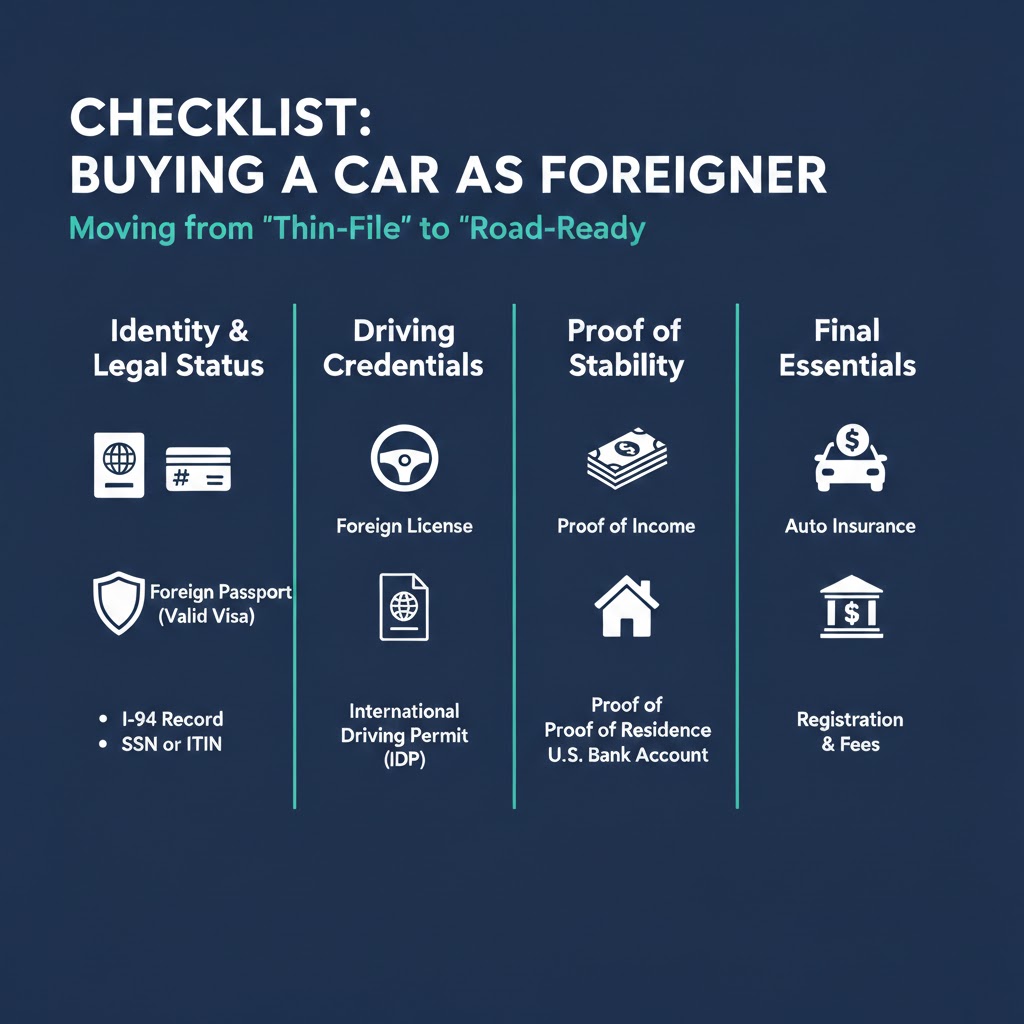
To prepare for buying a car in the USA as a foreigner, you'll generally need to gather:
- Proof of Identity: A valid foreign passport with a current visa (such as F-1, H-1B, or L-1) and your I-94 arrival record.
- Driver's License: A valid foreign driver's license is often accepted for the purchase, but you should carry an International Driving Permit (IDP) to translate your credentials.
- Proof of Income: Recent pay stubs, bank statements, or an employment verification letter to prove you can manage the payments.
- Proof of Residence: A utility bill or lease agreement showing your current U.S. address.
Understanding the Visibility Gap
One of the biggest hurdles when purchasing a vehicle is the "visibility gap." Most traditional lenders rely heavily on FICO® scores, which can take months or even years to build from scratch. This is a common challenge for those looking into How to Build Up Credit in 2025: A Practical Guide, as the system is often weighted against those without a long-standing history. Without this history, you may be asked for a significantly higher down payment-often between 20% and 35%- or be directed toward "buy-here, pay-here" dealerships that charge much higher interest rates.
Some specialized lenders now look at alternative data, such as your education and employment potential, rather than just a credit score. However, the most sustainable way to lower your car costs over time is to start building a traditional U.S. credit history as early as possible. This foundation is what allows you to move from being a "thin-file" borrower to someone with a profile that lenders trust.
Bridging the Visibility Gap with Cheers
For many newcomers, the real challenge isn't just buying a car; it's the invisible barrier of not having a credit history in a system that demands one. This "visibility gap" often forces people into expensive financial corners. At Cheers, we believe your financial potential shouldn't be ignored just because you're new to the country. We welcome everyone, including immigrants, to their credit journey with tools designed for those the traditional system overlooks.
Our Credit Builder tool works on autopilot to help you establish the very history lenders look for when approving auto loans. By reporting your monthly payment activity to all three major credit bureaus-Equifax, Experian, and TransUnion-you can build payment history and diversify your credit mix simultaneously¹. According to FICO®, 35% of your credit score is based on payment history, and 10% is based on credit mix². This proactive approach helps close the visibility gap, turning you into a "visible" and reliable borrower in the eyes of future lenders.
Navigating the Financing Maze
When you're new to the country, you'll encounter different types of financing. Dealership financing is convenient but can be more expensive for those without a credit score. Independent lenders or credit unions may offer "newcomer" programs specifically for visa holders. These programs often look at your job offer letter and salary rather than just a credit report.
Regardless of the lender, understanding how credit works is vital. Your credit score is a number that helps lenders decide how likely you are to repay debt. Most scores range from 300 to 850 and are based on factors like payment history and credit use. If you're starting, learning How to Build Credit: A Simple Guide to start today can give you the foundational knowledge to navigate these requirements more confidently.
How Cheers Accelerates Your Journey
Cheers isn't a bank; it's a financial technology company that partners with trusted institutions like Sunrise Banks, N.A., Member FDIC, to keep your funds secure. When you open a Credit Builder account, your monthly payments are securely held in a Certificate of Deposit (CD). This means while you're building your credit profile, you're also building a nest egg that is returned to you at the end of the term, minus interest³.
We use accelerated reporting, so your account and first payment are reported to all three credit bureaus within 15 days of account opening⁴. This is significantly faster than many traditional products that may take a whole month to report your first activity. For someone trying to get a car loan quickly, those extra weeks of reported history can make a real difference. In fact, internal user survey data from 2024 showed that 95% of users with fair credit saw an increase of 20+ points after just two months of on-time payments⁵.
Insurance and Registration Requirements
Once you've found the car and secured financing, you have to handle the legalities. You can't drive a car in the U.S. without insurance. For foreigners, insurance premiums might be higher initially because you don't have a U.S. driving record. Some companies will consider your driving history from your home country if you provide a certified English translation of your records.
After insurance is in place, you'll need to register the vehicle with your state's Department of Motor Vehicles (DMV). You'll pay sales tax and registration fees at this time. It's a good idea to check the myFICO Blog to see how taking on a new auto loan might affect your overall credit health and what to expect as your score begins to form.
Common Pitfalls to Avoid
Don't rush into a contract without reading the fine print. Some dealerships might try to add unnecessary "protection packages" or high-interest "gap insurance" to your loan. Always ask for the "Out the Door" price, which includes all taxes and fees, so there are no surprises when it's time to sign.
Also, be wary of "no credit check" loans that don't report to the credit bureaus. While they might get you a car today, they won't help you build the credit history you need for tomorrow. Cheers focuses on transparency, with a fixed 12.15% APR and no hidden fees⁶. There are no application fees, maintenance fees, or early cancellation penalties⁷.
Building a Stronger Future
Buying a car is just the first step. The goal is to reach a point where your credit score works for you, not against you. A higher score gives you access to better interest rates and more financial options. By staying consistent with your payments and monitoring your credit reports regularly, you can ensure your financial life in the U.S. is off to a great start.
At Cheers, we offer four monthly plans ranging from $24 to $144 per month over a 24-month period⁸. This flexibility allows you to choose a plan that fits your current budget while you're managing other moving costs. You're in control, and you can even cancel at any time without penalty⁹. This structure is built to ensure you aren't just spending money, but investing in your own financial visibility.
Conclusion
Immigrating to the U.S. is challenging, but buying a car in the USA as a foreigner is a significant milestone. Starting out with a lack of local credit history can feel like a significant roadblock, but with intentional and consistent credit building, you can develop a proactive strategy to lower interest rates. Focusing on building your credit early with a diverse credit mix and on-time payments, all the time, you open yourself up to better insurance rates, lower interest, and an overall better, stronger financial future.
Don't let the visibility gap hold you back from the lifestyle you've worked hard for. Establishing your credit doesn't have to be a mystery. Join Cheers today and start building the credit history you need for your next big purchase on autopilot.
Sign up for Cheers Credit Builder
This content is for informational purposes only and does not constitute financial advice. Please consult a licensed financial advisor or tax professional before making any financial decisions.
(The opinions expressed in this article are the author’s own and do not reflect the view of Sunrise Banks, N.A. Member FDIC⁹.)
References:
- myFICO Blog - https://www.myfico.com/credit-education/blog
Footnotes
1Payment activity: All payment activity is reported to the credit bureaus. On-time payments may help build your credit, while late or missed payments may negatively impact it. Results are not guaranteed and depend on your individual financial behavior and credit profile.
²FICO® Credit Factors: According to FICO®, 35% of your credit score is based on payment history, and 10% is based on credit mix. Cheers reports every payment and adds a secured installment loan to your profile. Source: myFICO: https://www.myfico.com/credit-education/whats-in-your-credit-score
³Cancel Anytime & Get Savings Back: At the end of your term, your total savings (minus interest) is returned to you. You can cancel your account at any time without penalty.
⁴Accelerated Reporting: Accelerated reporting applies to the opening of your account, plus the first payment. Credit bureau reporting occurs monthly thereafter
⁵Credit Score Impact: Based on internal user survey data (2024), 95% of users with fair credit (580–669) saw a credit score increase of 20+ points after two months of on-time payments. Individual results may vary. Late or missed payments can negatively affect your credit.
⁶APR Comparison & Affordability: Cheers Interest is calculated using an amortized repayment schedule at a fixed 12.15% Annual Percentage Rate (APR). Comparable products may charge APRs up to 36%, according to publicly available terms. Cheers also charges no administrative or hidden fees.
7No Hidden Fees: There are no application fees, maintenance fees, or early cancellation penalties.
8Credit Builder Account Plans: All plan options include a 24-month term, 25 total payments and a 12.15% Annual Percentage Rate (APR). Plan A: Total Payments of $600 with $532.70 Amount Financed. $24 Monthly Payments and $67.30 Total Interest. Plan B: Total Payments of $825.02 with $733.13 Amount Financed. $33 Monthly Payments and $91.89 Total Interest. Plan C: Total Payments of $1,149.98 with $1,021.69 Amount Financed. $46 Monthly Payments and $128.29 Total Interest. Plan D: Total Payments of $3,600.00 with $3,197.82 Amount Financed. $144 Monthly Payments and $402.18 Total Interest.
9Sunrise Banks: Cheers is a financial technology company and not a bank. Banking services are provided by Sunrise Banks N.A. Your funds are FDIC insured up to $250,000 through Sunrise Banks, N.A., Member FDIC. Results are not guaranteed. Improvement in your credit score is dependent on your specific situation and financial behavior. Failure to make monthly minimum payments by the payment due date each month may result in delinquent payment reporting to credit bureaus, which may negatively impact your credit score. This product will not remove negative credit history from your credit report. All loans are subject to approval. Must be at least 18 years old, have a valid U.S. bank account, and a Social Security Number.